
Why did I write my book?
'There we are human again: a diplomat's journey to anarchism' is published next week

Quick note: a reminder that I will be hosting a TikTok livestream at 7pm UK time, tonight (8 June). To join, follow me on TikTok.
My new book, ‘There we are human again: a diplomat’s journey to anarchism’ will be published on 9 June in the UK, and in August in the US. Last week, I circulated Jonathan Rowson’s entertaining blog about why he published it.

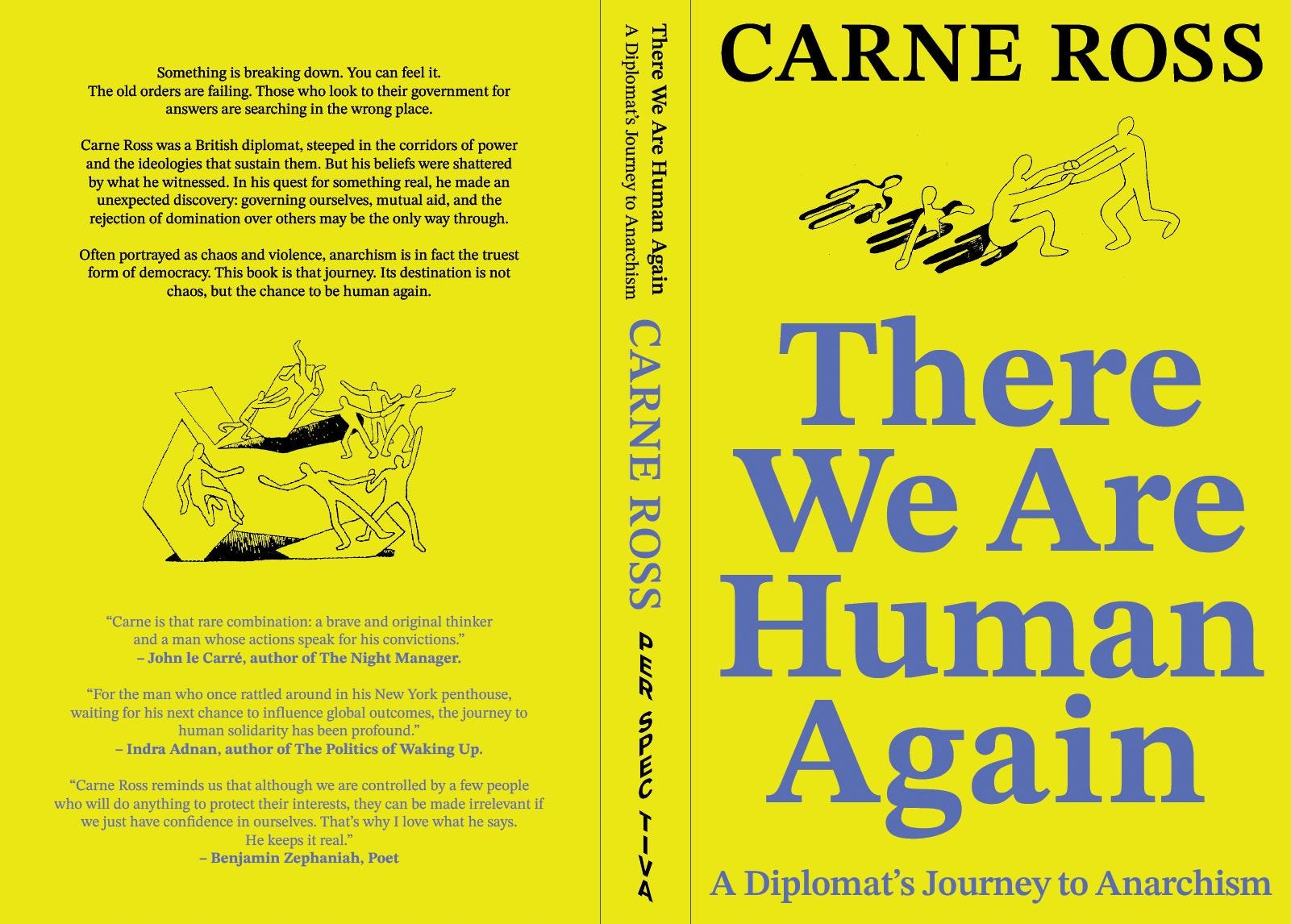
Here’s the cover, which I like. Jonathan and I debated the title to and fro on WhatsApp for at least four months (that’s what kind of publisher he is: ‘meticulous’ doesn’t quite capture it). We had a lot of bad ideas. His was,
‘Anarchy! Anarchy? Anarchy.’
Mine were (even) worse. More from exhaustion that anything else, we ended up with the current title (for which my wife Karmen must take much of the credit too). Hopefully, it will work though I’m not exactly the best judge.
Why did I write it? Several reasons, none of them wholly explicit or understood in my mind, like most of the forces that sweep us along.
First, I write. Like, I have to write. I don’t know why. But I do. I will be writing until I can no more. I have stacks of notebooks filled with decades’ worth of my melancholic and repetitive ramblings. My old boss, Robert Cooper, a very brilliant man, once told me that you write in order to think. It might simply be that.
Second, I want to leave something of me. A common urge, and a foolish one. At home, I have several enormous bags brimming with my grandfather’s papers and dozens of his books. Bound volumes of newspaper cuttings about himself reporting croquet victories in Southwick or his essays in Finnish philological journals (one of which gave rise to his most famous book, Noblesse Oblige). I am very slowly going through all this material; I doubt I will ever complete the task. I will probably be the only one who tries. When I die, I expect his papers will be thrown out. Eventually, his entry in Wikipedia will be deleted. He wrote lots of books, some of them best-sellers, but nothing will remain.
Third, my absolute amazement at how stupidly humans run their affairs. When I was growing up, I thought to myself, surely it’s obvious that we should not be divided by class, that everyone should have more or less the same and that countries, and indeed religions, are basically ridiculous constructs, that are inherited, unwanted, from history? Surely my generation would see sense and get rid of all this? It was not to be, at least not yet.
And threaded through this, all of it, was the persistent question, what do people want of life? What, indeed, do I want? Do I, do they, even know?
I studied economics and politics and thought I had learned a kind of answer, namely the simplistic and dangerous presumptions of neo-classical economics and representative democracy. One, that ‘rational’ people are driven by the desire to consume and that ultimately that individual urge is ‘better’ for everyone. Two, that the only way to prevent people killing each other is to take away a great many of their liberties and govern them with coercive authority - also known as the threat of violence, the defining feature of the state. Later, part of the point of my job as a British diplomat was to propagate these certitudes as logical and indeed the only way properly, fairly, to organise human affairs. I wrote speeches about this for the foreign secretary.
Then it all came crashing down with my resignation over Iraq. Somehow the realisation of the lies and viciousness of government, and the people I knew in it and whom I had liked but who didn’t question, didn’t obstruct, did nothing whatsoever to stop an illegal and exceptionally bloody war pulled away a brick in the bottom of the wall, and it collapsed. A close colleague of mine, the weapons scientist David Kelly, was hounded to suicide by a government he had loyally and expertly served. If government could destroy its own so ruthlessly, who exactly was it defending? The answer is obvious, itself.
So the search for better answers began. This is the story in the book.
It started with the same question: what do people want? Surely, whatever that is should be the purpose of any economics, any politics? Security, comfort, obviously but, equally obviously (unless you are a neo-classical economist), there is more. What could this be?
One afternoon I was in the NYU library on Washington Square. I was on sabbatical from the Foreign Office. I was reading a book, Ludwig Wittgenstein’s Tractatus Logico-Philosophicus. I don’t know why I was reading it. I think I just saw it on a shelf. Much of the book is pretty much unintelligible to anyone but a trained logician. But I caught its drift. The stuff that really matters cannot be put into words, or terms, at all. Wittgenstein famously said of this stuff,
Of which nothing can be said, nothing should be spoken1
This is really very obvious, unless you have been steeped for too long in the orthodoxies of western political and economic thought, as I had. So for me, it was revelatory.
So, what is this stuff we cannot name? Well, precisely that. The ineffable. Things that words can hint at, but can never capture in their fullest depth or import. Things like meaning, community, soul and, of course, love.
So, next question. What is a political or economic system that centres this ineffable stuff? That allows it to be the point, instead of the reductive claim that all we want is material, available to purchase, and that all we are is atomised individuals seeking to maximise our own ‘utility’, a model that attributes no value to, indeed ignores, the ineffable - the sound of leaves rustling in the wind, what it’s like to be hugged, friendship, cooperation, meaning. Why we get up in the morning. Why, in Camus’s question, we don’t just commit suicide.
Would anyone claim that the answer is what we have got today? A system that has given us rage on the streets, toxic politics, climate disaster, Putin, Trump; a society where teenagers stab one another because of the postcode they live in, where religious groups are terrorised and terrorise, where the language of hate metastasises across culture and debate and almost everyone feels real despair when they contemplate the future. Where my country, a supposed rights-respecting law-abiding democracy, can sell weapons to a country killing civilians in their tens of thousands, and this war crime like others before it is simply forgotten: ‘get over it’. One could go on.
The book charts what happened next. Ultimately, I came upon a kind of answer, and I’m still processing it. Because it was not what I expected, at all, and its ramifications are profound, not just for how we make decisions, but how we relate to each other and, indeed, how we live in this world.
While I was reading and researching, I started to write. I gave the manuscript a robust, macho title, ‘Militant Human’. It was supposed to describe a politics and economics that put humans, their needs, their wants, at its heart. I stopped writing it because I realised that others had mapped this path before me. Kropotkin, Goldman, Bookchin, Le Guin and, in his way, Lao Tzu, many centuries ago. Perhaps even Jesus. For Jesus was an anarchist. He blisteringly excoriated economic exploitation and the domination of authority. He venerated the poorest. ‘Render unto Caesar what belongs to Caesar’, read in context, actually means, Caesar has nothing (except the paltry coins with his face inscribed upon them). We live under god and what is god? God is love.
Anarchists reject religion for the very sensible reason that it has been perverted by those, usually men, who claim the right to interpret its lessons and thus dominate everyone else, usually corruptly. Anarchists reject anybody, any ideology, that seeks to tell us how to think and thus control us. They reject all authority, all exploitation, whether economic, racial, sexual or social. They reject everything that stops us living as we wish. Take all of it away and what are you left with? Just us. Looking at each other, wondering, what do we do now?
For we only truly exist in each other. Quantum physics offers an analogy - that the object only exists if the subject observes it. Humans only exist in relation to one another. This is why solitary confinement is a terrible kind of torture, because it removes the thing that makes us human: other people. Abdullah Ocalan, the imprisoned leader of the Kurdish liberation movement, the PKK, took it further. The subject/object distinction is the heart of the problem, he argued, with its implication that we and others (or we and nature) are separate in the first place. Eastern philosophies have, of course, been saying this for millennia.
Thus the core of any politics should be human relations, conducted without the poisonous constraints of economic compulsion (in capitalism, always exploitative, whether of other humans, or nature, or our psychic peace) which force us into the odious straitjacketed personalities of boss or bossed, the superior or the inferior, the successful or the failure (which most of us secretly feel we are). Without the state insistently telling us that without its violent authority (prison is violence, threat is violence, control is violence) we cannot be trusted to live peacefully together.
In the wilds of Siberia, the Russian naturalist (and Czarist prince) Pyotr Kropotkin found that the more distant a village from a centre of authority - a town, a police station, a court - the more its inhabitants cooperated with one another. Those who have experienced natural disaster, and the temporary absence of authority, find the same, as once I saw in New York City, of all places, after a hurricane. Not competition, but cooperation. Not violence, but love. Mutual aid, Kropotkin called it.
Scientifically, and with evidence, he rejected the reductive interpretations of Darwin’s theories - what was called ‘Social Darwinism’ - that humans’ natural state is to compete: ‘survival of the fittest’. Kropotkin had instead found that those who survive are, in fact, those who cooperate.
But the factory owners who owned the newspapers in Kropotkin’s day, the ‘social Darwinists’, won that battle for ‘the narrative’. Why they sought to do so is surely obvious: it was a philosophical and cultural excuse for 14-hour days and child labour in the smoking factories and fatal mines. They were sitting in plush gentlemen’s clubs in Pall Mall and the boardrooms of industry, and of course in government itself. Kropotkin was scribbling away, unnoticed, in Bromley (where you can still see his house today). His portrait sits above me now.
Today, it’s the same: those who benefit from a system of exploitation enforced by an allegedly ‘democratic’ government control the ‘narrative’ to the extent that it is barely ever questioned2: this is the ONLY way to live, the BEST way for humans to flourish, that ALL alternatives are ridiculous, utopian, fantastical. Pharaohs, Popes and monarchs once said the same. This will change, as all things must. The question is, to what?
Love does not, cannot, flourish between those with power and those without. Overweening power or the grotesque wealth that affords it, as Epstein so vividly demonstrates, fosters systemic abuse - of all kinds - without accountability. Love can only exist in equality when, at last, we fully see each other, when the many opaque veils of capitalist culture (winners/losers, dog-eat-dog) and petty authority are at last removed (an authority that, astonishingly, still decides whom we can marry and whose legal endorsement we still must seek when we marry). In those private spaces where there is only us.
This politics cuts deep, to the heart of what it is to be human.
It is a politics best discovered by the doing of it, not the telling, as we realise the deep-seated joy of working, living and loving together, only us, without distant authority deciding what we can and cannot do. Prefiguration, anarchists call it: the demonstration of a political idea through practice, through its very construction.
It’s not easy to preach anarchism. The counter-battery of self-appointed rationalists is powerful (for they have vested interests in dismissing all threat). It is hard to tackle the mostly unconscious assumptions of the status quo - that competition and self-seeking are the default of human behaviour, or the merciless ‘war of all against all’ that must inevitably accompany the absence of authority. I hear the softer version a lot, ‘People want to be told what to do!’ - and it’s always those who do the telling who make this claim. Those who get told don’t in fact say this, if you ask them.
These assumptions are everywhere, pronounced explicitly only sometimes, but more often subtly, insidiously, including in ‘culture’, art, commentary, zombie films, but perhaps worst of all inside the structure of our brains, the alignments of neurons long ago shaped by education, the numbing and thoughtless repetition of unquestioned ideas, culture and the insistent declarations of the small-minded but power hungry: the appalling, amoral, selfish, little men - killers, in truth - who somehow end up in charge: Putin, Netanyahu, Trump, [insert name of your most hated politician], propagating their absurd, awful and childish fantasies of nationalism or racial superiority, but also those who claim they want ‘the people’ to govern but only, it turns out, when they are in charge: the utter cynicism of Obama’s slogan ‘Yes we can’, a vacant promise with a thousand echoes in the painfully hollow and conformist theatre of ‘politics’ today where even those who claim they will change ‘the system’ have not a single idea on how to do so except through their occupation of Number Ten or the White House (Kanzleramt, Elysee etc) - having a few new taxes is not changing the system, sorry. A single man (sometimes a woman) when it is so very obvious that the necessary structural, cultural and indeed mental change will only come through the voluntary actions of the many, not the imposed decisions of a very few.
So, all this was why I wrote the book. It’s a statement of hope, that we can believe in something better, and through embodying and enacting that belief, make it so. It is an argument that we cannot know what it is to be truly human, because we have never been truly free. It is an examination of my own moral failures (above all, but sadly not only, when in government) and experiences, some good, some bad, some absurd, that led me inexorably to this conclusion, including my discovery of meaning, and indeed love, after the destruction of my world view, my profession and very sense of self.
Except that it isn’t a conclusion, it is more a waypoint on the road.
As I make my way along this path, I have realised that anarchism is much more than merely a proposal of how we should make decisions together - the transactions, the machine - or an argument that we can live without the fleeting comfort of soulless materialism if we have the joy and fulfilment of cooperation, of love, to sustain us instead. It goes deeper still.
For one thing separates anarchism from all other political philosophies, every one, and which makes it extraordinary and unique and indeed much more than a political philosophy, and more a spiritual quest. Unlike socialism, capitalism, communism, religion, you name it - every imposed ideology - it is not about how humans should be or how others, invariably those who benefit from the depiction, claim that humans are. Anarchism makes no claim, not one, about what we are. It is instead a kind of invitation to be what you what you might be, what you choose to be, without others telling you, without others coercing you: just you and those around you, free, at last, to explore a territory that hitherto, for all history, has been prohibited: what it is to be truly human.
You can pre-order the book here and receive occasional updates about book events - signings, discussions etc - and other news, including about my online courses, at my website.
An illustration of what kind of editor my publisher is, I sent him a draft of this post asking for a quick review. We ended up spending more than a day debating the correct translation of this quote, often translated as ‘Whereof we cannot speak, thereof we must remain silent’, including parsing the (much better and original) German version (‘Wovon man nicht sprechen kann, darüber muss man schweigen’), which does not involve antiquated words like ‘whereof’ - well it does but the word in German is still in regular usage - or requiring ‘one’ to use class-laden terms like ‘one’ - as well as consulting an academic authority on Wittgenstein, Rupert Read.
Though I sense that the questioning is growing, as the narrative’s consequences become ever more painfully evident.
Excellent Essay Carne. Looking forward to reading your book.